Ask anyone who knows Indian textiles about Jaipur’s block printing tradition and two names come up immediately: Sanganer and Bagru. They are both towns near Jaipur. Both have produced hand block-printed fabric for centuries. Both have been recognised as significant centres of Indian craft. And yet the two traditions could hardly be more different in aesthetic, technique, colour, and spirit.
Understanding the difference helps you choose the right Indian block print textiles for your home and appreciate exactly what you are buying when you pick up a block-printed bedsheet, curtain, or cushion cover.
Where they come from: the geography of two craft traditions
Sanganer is a town approximately 16 kilometres south of Jaipur, on the banks of the Saraswati River. It has been a centre of textile printing since at least the 17th century, historically favoured by the Jaipur royal court for its fine floral work. Today, Sanganer is essentially a suburb of Jaipur, home to hundreds of printing workshops and one of the densest concentrations of block printing artisans in the world.
Bagru is a smaller town about 30 kilometres west of Jaipur. Its printing tradition is older and more deeply rooted in indigenous craft the Chippa community of Bagru has practised natural-dye resist printing for generations, using techniques that predate synthetic dyes and modern colour chemistry. Bagru remains quieter, more artisanal, and less commercialised than Sanganer.
| Key geography: Sanganer 16 km south of Jaipur, fine floral block printing. Bagru 30 km west of Jaipur, natural-dye mud-resist printing. Both within the greater Jaipur textile belt. |
The Sanganer style: fine florals, vibrant colour, white backgrounds
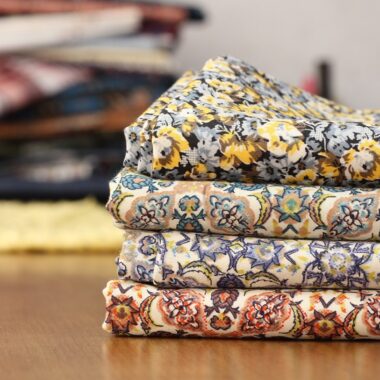
Sanganer printing is defined by intricate, detailed motifs fine-line florals, paisleys, botanical illustrations, and geometric lattice work printed on white or cream cotton backgrounds using vibrant, jewel-toned dyes. The designs are delicate and detailed, often inspired by Mughal court aesthetics: flowers, vines, leaves, and birds rendered with a precision that requires skilled carvers and experienced printers.
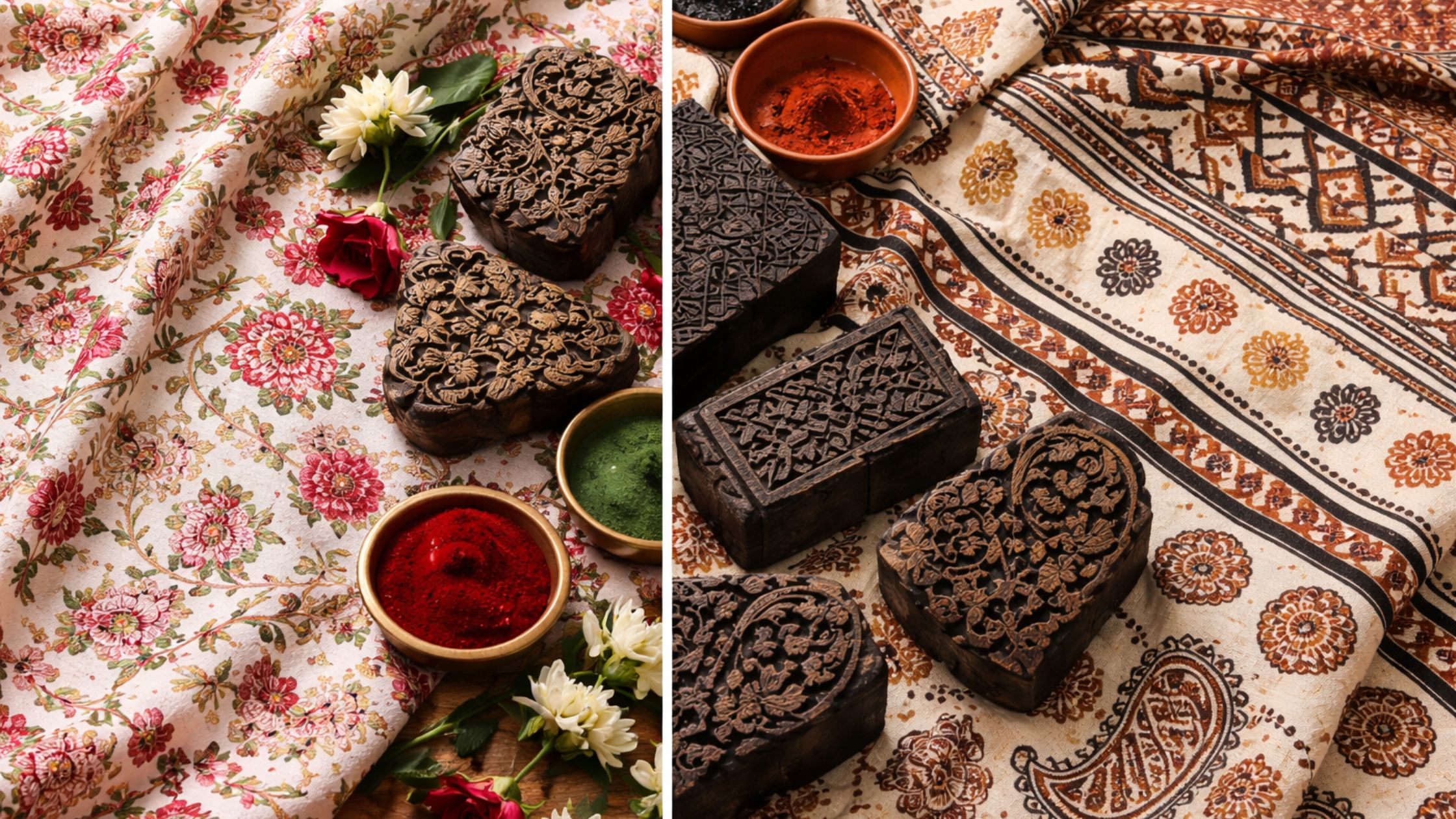
The technique uses AZO-free synthetic dyes applied via carved wooden blocks. The fabric is laid on long padded printing tables; the printer stamps each block precisely, aligning every repeat by eye and experience. A three-colour Sanganer print might use three separate blocks applied in sequence, each requiring its own dye bath and drying time.
- Colour palette: Bright, vibrant pinks, blues, reds, teals, greens, saffron on white or off-white ground
- Motifs: Fine floral and paisley, Mughal-inspired botanical, geometric lattice, peacock and bird motifs
- Background: Almost always white or very pale the contrast is central to the aesthetic
- Dyes: AZO-free synthetic dyes colourfast, washable, available in a wide colour range
- Products: Bedsheets, curtains, dupattas, cushion covers, tablecloths anything that benefits from a fine, detailed print
The Bagru style: earthy, bold, natural, resist-printed
Bagru printing is a fundamentally different process. The dominant technique is dabu a mud-resist method where a paste made of clay, lime, gum, and wheat chaff is applied to the fabric using carved blocks before dyeing. When the fabric is immersed in a natural dye bath, the resist paste prevents the dye from penetrating those areas, creating the pattern in the original cloth colour against a dyed background.
The result is earthy, textured, and deeply organic. Bagru prints are bold rather than fine the motifs are geometric: diamonds, chevrons, concentric circles, and abstract florals with thick outlines. The colours are the colours of Rajasthan’s landscape: indigo, madder red, pomegranate yellow, iron black, and earthen brown all derived from natural sources or natural-mineral processes.
- Colour palette: Earthy, muted indigo blue, madder red, iron black, pomegranate brown, natural beige ground
- Motifs: Bold geometric diamonds, chevrons, concentric forms, abstract florals with thick outlines
- Background: The cloth’s natural beige or cream colour, revealed by the resist process
- Dyes: Natural dyes or natural-mineral processes indigo, alizarin (madder), iron mordant
- Products: Heavier home furnishings, statement throws, upholstery fabric, sarees, wall hangings where bold scale and natural tones suit
Side-by-side comparison
| Feature | Sanganer printing | Bagru printing |
| Technique | Direct block stamping with AZO-free dyes | Mud-resist (dabu) then natural dye bath |
| Background | White or pale dye on ground | Natural beige/cream ground shows through resist |
| Colour range | Vibrant, wide spectrum | Earthy, muted, natural-dye palette |
| Motif style | Fine floral, paisley, Mughal-inspired | Bold geometric, thick-outline abstract floral |
| Scale of pattern | Small to medium, detailed | Medium to large, graphic |
| Aesthetic | Delicate, traditional, festive | Rustic, organic, contemporary earthy |
| Best home use | Bedsheets, curtains, cushion covers | Statement throws, heavy upholstery, wall art |
| Interior style | Traditional Indian, Indo-Mughal, bohemian | Rustic, minimal, Japandi, earthy modern |
| Washability | Machine washable, colourfast | Wash care varies natural dyes need care |
Which style is right for your home?
Choose Sanganer printing if you want…
- Bedsheets, curtains, and cushion covers in coordinating traditional Indian prints
- Vibrant colour on a clean white or cream background that works in brightly lit Indian rooms
- Fine, detailed motifs that feel festive and traditional popular for Diwali gifting and wedding seasons
- Products that are machine washable with long-term colour stability
Choose Bagru printing if you want…
- A rustic, earthy, organic aesthetic heavy furnishing fabric, statement throws, or wall hangings
- Natural dyes and traditional craft process as a priority the full sustainability story
- Bold graphic patterns that work in minimal, contemporary, or Japandi-influenced interiors
- A textile that tells a more raw, less refined craft story
Indian Fabrico’s home linen range primarily uses Sanganer-style printing the fine floral and paisley motifs that appear across our king size bedsheets, hand block printed curtains, and cushion covers are all Sanganer work, produced by artisans in Jaipur’s Sanganer workshops. For the full story of how this printing fits into India’s wider block print heritage, read our guide to Indian hand block printing techniques.
How to identify genuine block-printed fabric Sanganer or Bagru
- Pattern variation: Each hand-stamped repeat has slight variations in colour depth or alignment. Machine-printed fabric is perfectly uniform throughout. Variation is quality, not a flaw.
- Reverse side penetration: Hold genuine block-printed fabric up to the light. Natural or AZO-free dye penetrates the fibre you will see colour on the reverse. Machine printing sits on the surface.
- Dye depth variation: In a genuine Sanganer piece, closely inspect the colour. It is slightly deeper where the block pressed hardest, lighter at the outer edges of each stamp. Machine printing is flat and even.
- Block join lines: Look for the faint lines where one block stamp meets the next repeat. In skilled Sanganer work these are nearly invisible; in Bagru work they are a proud feature of the technique.
| Buyer note: Many products online claim ‘block print’ but are actually screen-printed or digitally printed with a block-print design. These are cheaper and perfectly washable, but they are not hand block printed. Ask the seller specifically whether the print is hand-stamped with carved wooden blocks, or screen/digitally printed. |
To coordinate Sanganer block prints across your home, explore the diwan sets collection (which includes matching bedsheet, bolster covers, and cushion covers in coordinating Sanganer prints) and the hand block towel sets for bathroom coordination.
Frequently Asked Questions (FAQs)
Sanganer printing uses direct block stamping with AZO-free synthetic dyes to create fine floral and paisley motifs on white or pale cotton backgrounds vibrant, detailed, and well-suited to bedsheets and curtains. Bagru printing uses a mud-resist (dabu) technique with natural dyes to create bold geometric patterns in earthy tones of indigo, madder red, and brown on natural-beige cotton. Both are from near Jaipur, Rajasthan, but produce very different aesthetics.
Sanganer-style block printing is most commonly used in Indian bedsheets, curtains, and cushion covers because its fine floral motifs and vibrant colours on white cotton work beautifully in bedroom settings. Bagru printing tends to be used for heavier statement textiles, furnishing fabric, and throws. Indian Fabrico uses authentic Sanganer-style printing for all block-printed home linen.
Yes, Sanganer block printing uses AZO-free synthetic dyes that are fixed and colourfast. Machine wash in cold water on a gentle cycle with mild liquid detergent. Wash new items separately for the first 2–3 washes as a precaution. Air dry in shade. Avoid bleach or hot water. Indian Fabrico’s block-printed bedsheets and curtains are fully machine washable.
Traditional Bagru prints use natural dyes indigo, madder (alizarin), iron mordant, and pomegranate rind. Contemporary Bagru workshops often use a combination of natural and mineral-based dyes. The dabu resist paste itself (clay, lime, gum, wheat chaff) is always natural. Natural-dye Bagru prints require more careful washing cold water, gentle detergent, no bleach to preserve the muted natural palette.
Slight variations in colour depth, pattern alignment, and repeat spacing are the hallmark of genuine hand block printing. Each stamp is made by a human hand pressing a carved block onto the fabric no two stamps are identical. These variations are evidence of craftsmanship, not manufacturing defects. Machine-printed and screen-printed fabrics are perfectly uniform throughout; hand block prints are not.
Indian Fabrico sells authentic Sanganer-style hand block printed bedsheets, curtains, cushion covers, and diwan sets sourced directly from Jaipur’s Sanganer artisan community no middlemen. Products are made in Jaipur and shipped across India (free shipping) and internationally to 10+ countries including Australia, UK, USA, Canada, and UAE.